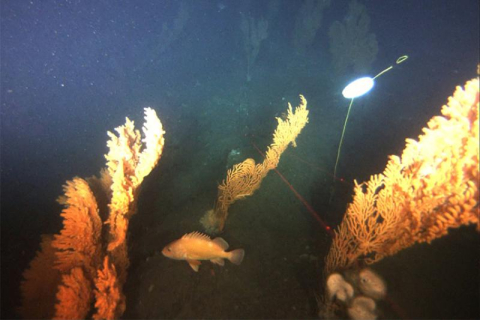
NOAA’s National Database for Deep-Sea Corals and Sponges: 2020 Status Update

The National Oceanic and Atmospheric Administration's Deep Sea Coral Research and Technology Program compiles, curates, and makes public a National Database of biogeographic data and information on deep-sea corals and sponges. This report details developments and enhancements to the database since it became accessible through the online portal in 2015.
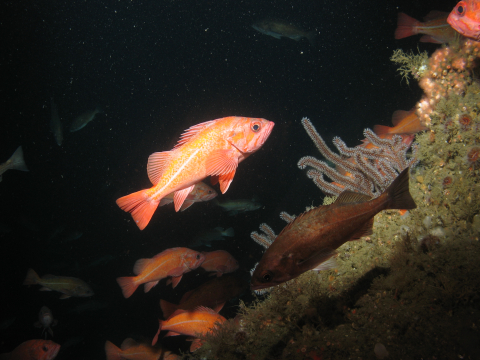
Deep Sea Coral Research and Technology Program 2022 Report to Congress

This report summarizes fiscal year 2020 and 2021 activities that supported management decisions, improved our understanding of deep-sea coral and sponge communities, and leveraged partnerships to enhance operational efficiency and effectiveness. Operating through NOAA Fisheries’ Office of Habitat Conservation, and funded at approximately $2.3 million annually to support national-scale research, the Program collaborates widely and leverages substantial funding to study the role of corals in support of deep-sea ecosystems.

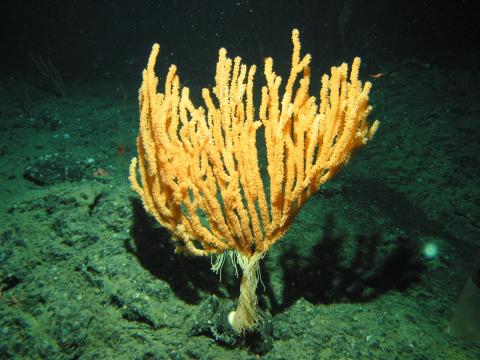
Deep Sea Coral Research and Technology Program 2020 Report to Congress

This report summarizes fiscal year 2018 and 2019 activities that supported management decisions, improved our understanding of deep-sea coral communities, and prioritized partnerships to enhance operational efficiency and effectiveness. Operating through NOAA Fisheries’ Office of Habitat Conservation, and funded at approximately $2.3 million annually to support national-scale research, the Program collaborates widely to cost-effectively study the role of corals in support of deep-sea ecosystems.

Good Practices for Species Distribution Modeling of Deep-Sea Corals and Sponges for Resource Management: Data Collection, Analysis, Validation, and Communication

Species distribution modeling provides a cost-effective means of identifying potential deep-sea coral and sponge habitat over large areas to inform these management decisions and data collection. Here we describe good practices for deep-sea coral and sponge species distribution modeling, especially in the context of data collection and management applications. 

A Review of Resource Management Strategies for Protection of Seamounts

marine resources conservation; seamounts; submarine topography

Over the past decade, there has been a strong push to protect seamount communities from threats ranging from deep-sea fishing to harvesting of non-living marine resources. A number of resource protection mechanisms exist for seamounts, ranging from national legislation to multi-lateral agreements to conserve seamounts on the high seas, using the authority of international instruments.

Models and Maps: Predicting the Distribution of Corals and Other Benthic Macro-Invertebrates in Shelf Habitats

model; shelf; habitat

Presence-absence data of benthic macro-invertebrates and associated habitat (i.e., sediment type and depth) were collected using a towed camera sled in selected areas along the coast off southern California. Using this information, we developed generalized linear models to predict the probability of occurrence of five commonly observed taxa (cup corals, hydroids, short and tall sea pens, and brittle stars in the sediment) within the Santa Barbara Channel.

NOAA Strategic Plan for Deep-Sea Coral and Sponge Ecosystems: Research, Management, and International Cooperation

Coral Reef Ecology; Deep Sea Corals; Management; Marine Ecosystem Management; Planning; Research; Sponges

This document addresses an identified milestone in NOAA’s five-year Research Plan for 2005-2009 to develop a NOAA-wide research plan for deep-sea corals; and a commitment by NOAA to develop a national strategy for research and conservation of deep-sea corals and sponges in response to a petition from Oceana to protect deep-sea corals and sponge

Managing Fishery Impacts on Deep-Water Coral Ecosystems of the USA: Emerging Best Practices

Deep-sea coral; Vulnerable marine ecosystems; Essential fish habitat; Fishing impacts; Trawling; Marine conservation; Marine protected areas

The present study reviews US efforts to address fishing impacts on vulnerable deep-sea habitats, particularly deep-water corals, and highlights approaches that are emerging as US best-practices in the context of ecosystem approaches to fisheries management.

Subscribe to National