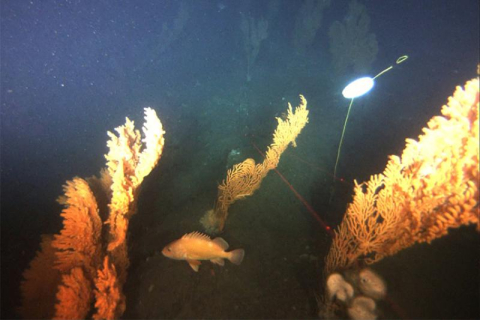
An Annotated and Illustrated Identification Guide to Common Mesophotic Reef Sponges (Porifera, Demospongiae, Hexactinellida, and Homoscleromorpha) Inhabiting Flower Garden Banks National Marine Sanctuary and Vicinities

In Flower Garden Banks National Marine Sanctuary region within the northwestern Gulf of Mexico, sponges thrive among diverse biological and geological habitats between 16–200+ m deep (i.e., coral reefs and communities, algal nodules, and coralline algae reefs, mesophotic reefs, patch reefs, scarps, ridges, soft substrate, and rocky outcrops).
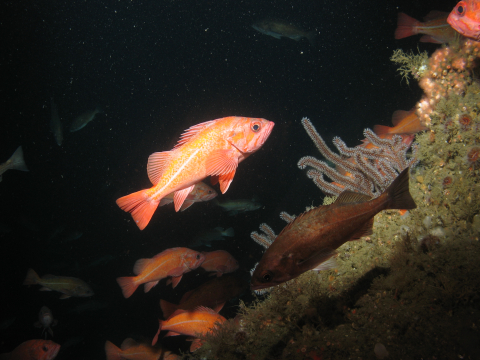
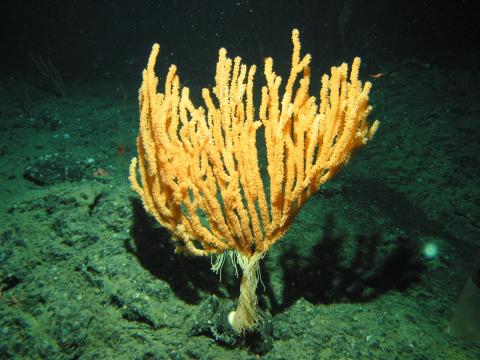
Antipatharians of the Mesophotic Zone: Four Case Studies

A review of taxonomic and ecological studies for shallow and mesophotic antipatharians is presented for four regionally based case studies, three in the tropics (1) Central Indo-Pacific, plus adjacent sections of the Western Indo-Pacific, (2) Eastern Indo-Pacific (primarily Hawaiʻi), and (3) the Caribbean Sea) and one at temperate latitudes in the Mediterranean Sea and adjacent sections of the Northeast Atlantic. 

Cruise Report for NOAA Ship Nancy Foster NF-19-01: Mapping Essential Fish Habitat in the US Caribbean to Inform MPA Management (2019)

The purpose of this cruise (project number NF-19-01) in particular was to collect multibeam sonar bathymetry, acoustic backscatter, remotely operated vehicle optical validation, and fishery acoustics within coastal waters of Puerto Rico and the US Virgin Islands. Scientists collected high-resolution multibeam and fishery acoustic data in mid-water depths approximately 11 to 3066 meters, in order to continue characterizing seafloor habitats within all U.S. States, Territories, and Commonwealths.

Photographic Catalog of Deep-Sea Corals Collected from the US West Atlantic Margin by NOAA ship Okeanos Explorer in Years 2017–2019

This photo-identification collection is intended to provide a visual reference to commonly observed deep-sea corals in the Southeast United States, Gulf of Mexico, and U.S. Caribbean, as a consensus aid for taxonomic identification of these organisms. This document also aims to provide an effectual representation of the diversity of coral fauna encountered in the deep-sea of this greater U.S. Southeast region (defined here as > 200 m deep) by the NOAA Office of Ocean Exploration and Research, using remotely operated vehicle Deep Discoverer in years 2017-2019.

Models of Habitat Suitability, Size, and Age-Class Structure for the Deep-Sea Black Coral Leiopathes glaberrima in the Gulf of Mexico

A large number of remotely operated vehicle surveys have been conducted in the Gulf of Mexico deep sea since 2008, including telepresence cruises that broadcast live seafloor images to shore. Visual observations from these surveys were collated and geo-referenced in a regional database with national museum records in order to: (1) map the distribution of L. glaberrima throughout the U.S. Gulf of Mexico, (2) predict the distribution of L.

Validation of Image-Based Species Identifications of Black Corals (Order Antipatharia) on Mesophotic Rocks

As image-based identifications become a predominant method for deep-sea species characterizations, there is a need to evaluate the accuracy of species- and genus-level identifications from video and still images to provide a reliable measure of biodiversity. This study presents a validation of the ability to make accurate image-based identifications of black coral species in the northwestern Gulf of Mexico from standard-definition video collected by a remotely operated vehicle.

Turning the Lights On for Deep-Sea Ecosystems in the Caribbean, Gulf of Mexico, and U.S. Southeast Atlantic

This full-day session of the ASLO 2019 Aquatic Sciences Meeting served as a forum to highlight recent advances in the understanding of deep-sea ecosystems in the western North Atlantic region encompassed by the Caribbean, Gulf of Mexico (GoM), and U.S. Southeast Atlantic.

A Framework for the Development of a Global Standardised Marine Taxon Reference Image Database (SMarTaR-ID) to Support Image-Based Analyses

Using the North Atlantic deep sea as a case study, we propose a database structure to facilitate standardisation of morphospecies image catalogues between research groups and support future use in multiple front-end applications. We also propose a framework for coordination of international efforts to develop reference guides for the identification of marine species from images.

Subscribe to Southeast (South Atlantic/Gulf of Mexico/U.S. Caribbean)