NOAA West Coast Deep-Sea Coral Initiative 2018-2021: Final Report

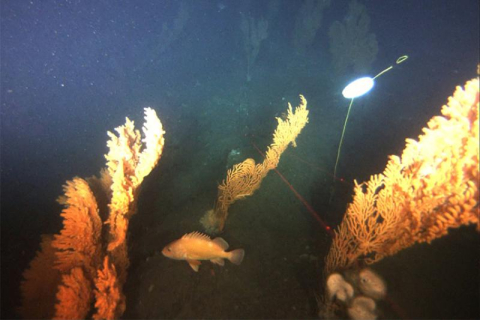
This report summarizes the objectives, accomplishments, and outcomes of NOAA's West Coast Deep-Sea Coral Initiative, funded by the Deep Sea Coral Research and Technology Program. The four-year initiative (2018-2021) was designed to explore, map, characterize, and conduct research on deep-sea coral and sponge habitats in the Pacific Fishery Management Council region, inclusive of waters off California, Oregon, and Washington.
An Annotated and Illustrated Identification Guide to Common Mesophotic Reef Sponges (Porifera, Demospongiae, Hexactinellida, and Homoscleromorpha) Inhabiting Flower Garden Banks National Marine Sanctuary and Vicinities

In Flower Garden Banks National Marine Sanctuary region within the northwestern Gulf of Mexico, sponges thrive among diverse biological and geological habitats between 16–200+ m deep (i.e., coral reefs and communities, algal nodules, and coralline algae reefs, mesophotic reefs, patch reefs, scarps, ridges, soft substrate, and rocky outcrops).

A Characterization of Deep-Sea Coral and Sponge Communities in Areas of High Bycatch in Bottom Trawls off Northern California

Using an autonomous underwater vehicle (AUV) and towed camera system (TCS), deep-sea corals, sponges, and seafloor habitats were visually surveyed for the first time in areas of longtime trawl fishing off northern California. During an 11-day cruise aboard the R/V Point Sur 8-18 September 2014, researchers completed 6 dives with the AUV and 9 deployments of the TCS, and spent over 42 hours underwater at depths of 586-1169 meters from the Oregon-California border to the Mendocino Ridge.

Subscribe to Sponges