Research Priorities Workshop Report for the DSCRTP West Coast Research Initiative 2018-2021

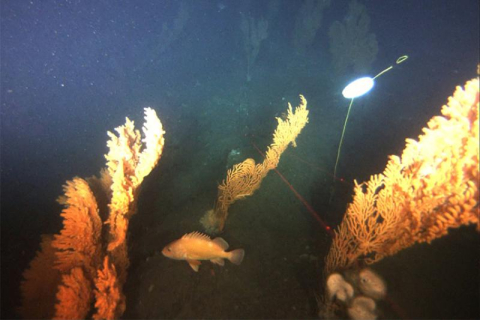
The National Oceanic and Atmospheric Administration Deep Sea Coral Research and Technology Program’s convened a 2-day science priorities workshop on April 16-17, 2018 at the University of California, Santa Barbara. The purpose of the workshop was to build partnerships and set research priorities for the Program’s 4-year West Coast Deep-Sea Coral Initiative (WCDSCI; 2018-2021).
First In Situ Observation of an Aphyonid Fish (Teleostei, Ophidiiformes, Bythitidae)

Aphyonids are poorly-known, live-bearing brotulas (Ophidiiformes, Bythitidae) that until recently were considered to be in a distinct family, Aphyonidae. A single, ca. 9.3 cm total length aphyonid observed during a remotely-operated vehicle survey in the Mariana Archipelago at 2504.2 m on Explorer Ridge (20.68152°N, 145.08750°E) is the first seen alive in its natural habitat.

Primnoidae (Cnidaria: Octocorallia: Calcaxonia) of the Okeanos Explorer Expeditions (CAPSTONE) to the Central Pacific

*Journal subscription required to access

This paper discusses and illustrates the 23 primnoid species collected by the R/V Okeanos Explorer in the US marine protected areas in the central and western Pacific, ranging from the Musician Seamounts in the north to American Samoa to the south, and the northern Mariana Islands to the west (CAPSTONE expeditions, 2015-2017). In situ photographs are provided for most species.

Models of Habitat Suitability, Size, and Age-Class Structure for the Deep-Sea Black Coral Leiopathes glaberrima in the Gulf of Mexico

A large number of remotely operated vehicle surveys have been conducted in the Gulf of Mexico deep sea since 2008, including telepresence cruises that broadcast live seafloor images to shore. Visual observations from these surveys were collated and geo-referenced in a regional database with national museum records in order to: (1) map the distribution of L. glaberrima throughout the U.S. Gulf of Mexico, (2) predict the distribution of L.

The Potential Effects of Substrate Type, Currents, Depth and Fishing Pressure on Distribution, Abundance, Diversity, and Height of Cold-Water Corals and Sponges in Temperate, Marine Waters

*Journal subscription required to access

From 2010 to 2014, underwater camera surveys in the Aleutian Islands were completed with the objective of evaluating potential effects of substrate type, tidal currents, depth, and fishing pressure on distribution, abundance, diversity, and size of structure-forming invertebrate communities. The presence of rocky substrates was associated with higher probability of presence, higher density, and taller structure-forming invertebrates.

Subscribe to 2018