New Species of Stylasterid (Cnidaria: Hydrozoa: Anthoathecata: Stylasteridae) from the Northwestern Hawaiian Islands

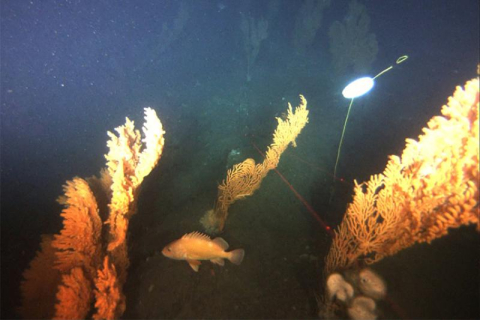
A new species of Crypthelia, C. kelleyi, is described from a seamount in the Northwestern Hawaiian Islands, making it the fifth species of stylasterid known from the Hawaiian Islands. Collected at 2,116 m, it is the fourth-deepest stylasterid species known.

CAPSTONE: Exploring the US Marine Protected Areas in the Central and Western Pacific

NOAA and its partners initiated CAPSTONE expeditions aboard Okeanos Explorer in July 2015. In addition to providing valuable information on the habitats and species in these MPAs, CAPSTONE also aims to contribute publicly accessible baseline data and critical information needed to respond to emerging regional issues such as deep-sea mining, sustainable deep-sea fisheries, and potential US ECS designation.

Geological Interpretation of Volcanism and Segmentation of the Mariana Back-Arc Spreading Center Between 12.7°N and 18.3°N

The relationships between tectonic processes, magmatism, and hydrothermal venting along ∼600 km of the slow-spreading Mariana back-arc between 12.7°N and 18.3°N reveal a number of similarities and differences compared to slow-spreading mid-ocean ridges. Analysis of the volcanic geomorphology and structure highlights the complexity of the back-arc spreading center. Here, ridge segmentation is controlled by large-scale basement structures that appear to predate back-arc rifting.

A Five-Year, In Situ Growth Study on Shallow-Water Populations of the Gorgonian Octocoral Calcigorgia spiculifera in the Gulf of Alaska

Colonies of the holaxonian Calcigorgia spiculifera were tagged beginning in 1999 at three sites in Chatham Strait, Southeast Alaska, using scuba and their growth measured annually for up to 5 years. Colonies were video recorded, and computer image analysis tools provided calibration of video images for measuring the length of several branches. 

Linear Correlations in Bamboo Coral δ13C and δ18O Sampled by SIMS and Micromill: Evaluating Paleoceanographic Potential and Biomineralization Mechanisms Using δ11B and ∆47 Composition

deep-sea corals; paleoclimate; oxygen isotope; clumped isotope; boron isotope; SIMS; vital effect

Recent work demonstrates that bamboo coral growth temperature, averaged over its entire lifespan, can be derived from linear correlations in its carbon and oxygen isotope composition (δ13C, δ18O) when the apparent equilibrium fractionations for a coral's growth rate and calcifying pH are used. Building on this method, this study applies it to coeval coral skeleton to assess the possibility of extracting paleoceanographic timeseries from bamboo coral skeletons.

Comparisons of Methods for Modeling Coral and Sponge Distribution in the Gulf of Alaska

Deep-sea coral and sponge ecosystems are widespread throughout most of Alaska's marine waters, and are associated with many different species of fishes and invertebrates. These ecosystems are vulnerable to the effects of commercial fishing activities and climate change. We compared four commonly used species distribution models (general linear models, generalized additive models, boosted regression trees and random forest models) and an ensemble model to predict the presence or absence and abundance of six groups of benthic invertebrate taxa in the Gulf of Alaska.
Validation of Deep-Sea Coral and Sponge Distribution Models in the Aleutian Islands, Alaska

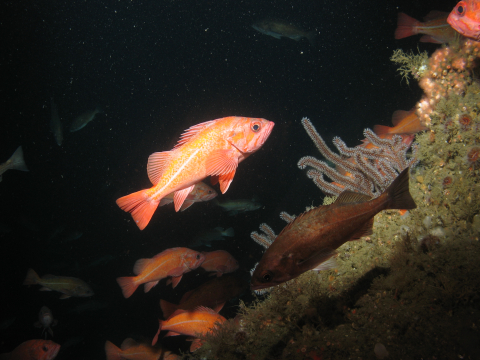
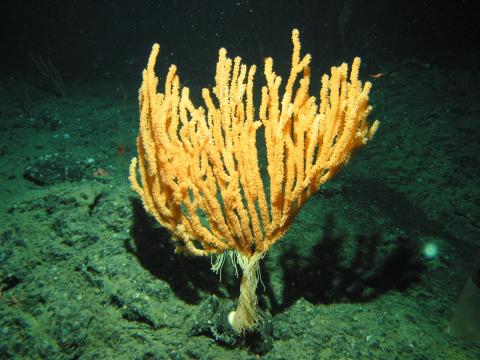
Spatial management of vulnerable benthic ecosystem components such as deep-sea corals and sponges requires adequate maps of their distribution. These maps are often based on statistical models of survey data. The objective of this project was to validate the predictions of existing presence or absence and abundance models of deep-sea corals and sponges in the Aleutian Islands that were based on bottom trawl survey data.

Subscribe to 2017