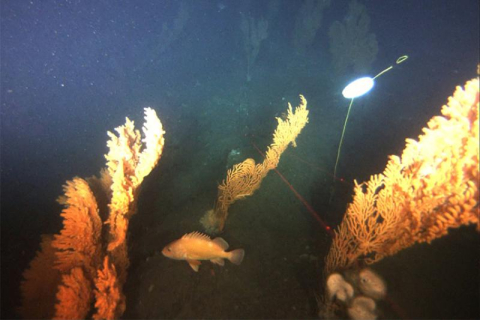
A Survey of Deep-Water Coral and Sponge Habitats Along the West Coast of the U.S. Using a Remotely Operated Vehicle: NOAA Fisheries Survey Vessel (FSV) Bell M. Shimada, November 1-5, 2010

deep-sea corals; fish surveys; ocean bottom ecology; remote sensing; sponges

Remotely operated vehicle (ROV) surveys were conducted from NOAA’s state‐of‐the‐art Fisheries Survey Vessel (FSV) Bell M. Shimada during a six‐day transit November 1‐5, 2010 between San Diego, CA and Seattle, WA. The objective of this survey was to locate and characterize deep‐sea coral and sponge ecosystems at several recommended sites in support of NOAA’s Coral Reef Conservation Program.
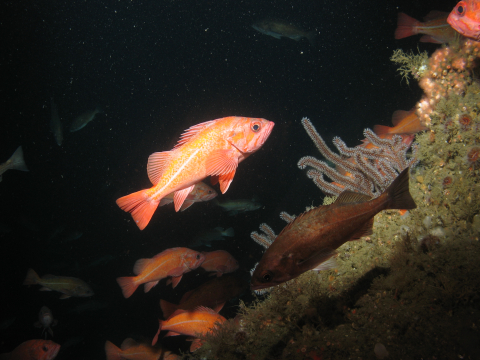
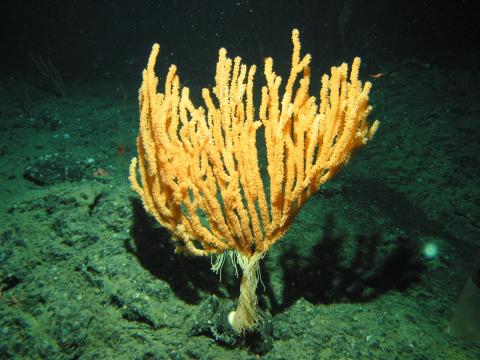
A Characterization of the Coral and Sponge Community on Piggy Bank Seamount in Southern California from a Survey Using a Remotely Operated Vehicle

conservation; deep-sea corals; effect of humans on; habitat; marine ecosystem management; seamounts; sponges

A coast-wide survey of the distribution and abundance of deep-sea corals from Washington to southern California was conducted during three legs of a cruise aboard the NOAA ship McArthur II. The report provides a summary of the methods and results from underwater surveys of corals, sponges, and associated habitats, invertebrates, and fishes conducted during Leg 3 of the cruise using the ROV on a deep rocky seamount in the Southern California Bight.

A Characterization of Deep-Sea Coral and Sponge Communities on the Continental Shelf of Olympic Coast National Marine Sanctuary, Northern Washington, Using a Remotely Operated Vehicle in June 2010

Site Characterization; Olympic Coast

This report provides a summary of the methods and results from underwater surveys of corals, sponges, and associated habitats, invertebrates, and fishes conducted during Leg 1 of the cruise using the ROV to survey hard bottom substrates previously mapped with side-scan sonar and/or multibeam bathymetry in the Olympic Coast National Marine Sanctuary that had high likelihood of suitable habitats for deep-sea coral communities.

NOAA Deep-sea Coral and Sponge Ecosystems Exploration and Research Priorities Workshop for the Northeast U.S., James J. Howard Marine Science Laboratory, Highlands, NJ, August 9-10, 2011

Coral Reef Ecology; Deep Sea Corals; Management; Marine Ecosystem Management; Research; Sponges

The ultimate goal of the workshop was to identify steps necessary to improve the understanding needed to conserve and manage these deep-sea ecosystems. Workshop participants represented a broad range of stakeholders including the Federal government, the New England and the Mid-Atlantic Fishery Management Councils, academia, private industry, nongovernmental organizations and Canadian academic and governmental representatives

A characterization of deep-sea coral and sponge communities on the continental slope west of Cordell Bank, Northern California using a remotely operated vehicle

Site characterization

This report provides summary results from leg 2 (Central California) of the 2010 effort in which a Remotely Operated Vehicle (ROV) was deployed from the NOAA ship McArthur II to survey potential deep-sea coral habitat.

A characterization of the deep-sea coral and sponge community in Bodega Canyon off the coast of California from a survey using an autonomous underwater vehicle

In 2010, the Program initiated a three- year study to advance our understanding of deep-sea corals off the west coast of the U.S.  The following study was a part of this research. A broad-scale characterization of deep-sea coral/sponge habitats and communities was conducted in Bodega Canyon during late summer of 2011 using still photo observations from an autonomous underwater vehicle (AUV). 

Subscribe to 2011