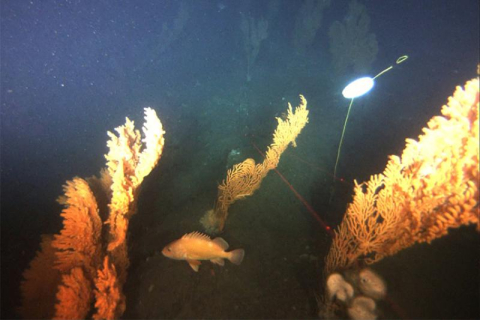
NOAA’s National Database for Deep-Sea Corals and Sponges: 2020 Status Update

The National Oceanic and Atmospheric Administration's Deep Sea Coral Research and Technology Program compiles, curates, and makes public a National Database of biogeographic data and information on deep-sea corals and sponges. This report details developments and enhancements to the database since it became accessible through the online portal in 2015.
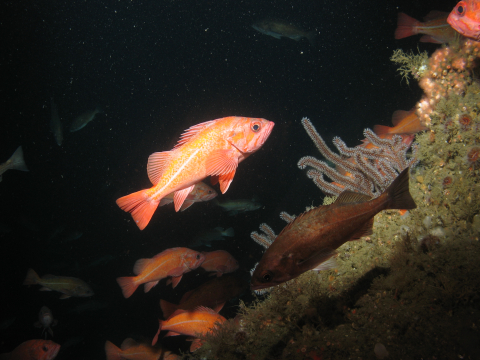
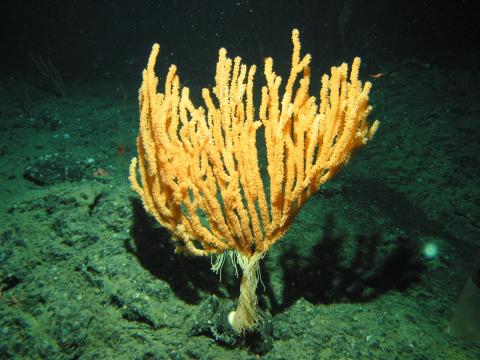
NOAA West Coast Deep-Sea Coral Initiative 2018-2021: Final Report

This report summarizes the objectives, accomplishments, and outcomes of NOAA's West Coast Deep-Sea Coral Initiative, funded by the Deep Sea Coral Research and Technology Program. The four-year initiative (2018-2021) was designed to explore, map, characterize, and conduct research on deep-sea coral and sponge habitats in the Pacific Fishery Management Council region, inclusive of waters off California, Oregon, and Washington.

Marine Biogeographic Assessment of the Main Hawaiian Islands: A Collaborative Investigation

The Bureau of Ocean Energy Management partnered with the National Oceanic and Atmospheric Administration’s National Centers for Coastal Ocean Science to gather biogeographic information in support of this evaluation around the Main Hawaiian Islands . The complexity of products from this assessment range from simple animal distribution maps to mathematical models depicting the predicted distributions of animals.

Cruise Report for NOAA Ship Nancy Foster NF-19-01: Mapping Essential Fish Habitat in the US Caribbean to Inform MPA Management (2019)

The purpose of this cruise (project number NF-19-01) in particular was to collect multibeam sonar bathymetry, acoustic backscatter, remotely operated vehicle optical validation, and fishery acoustics within coastal waters of Puerto Rico and the US Virgin Islands. Scientists collected high-resolution multibeam and fishery acoustic data in mid-water depths approximately 11 to 3066 meters, in order to continue characterizing seafloor habitats within all U.S. States, Territories, and Commonwealths.

Photographic Catalog of Deep-Sea Corals Collected from the US West Atlantic Margin by NOAA ship Okeanos Explorer in Years 2017–2019

This photo-identification collection is intended to provide a visual reference to commonly observed deep-sea corals in the Southeast United States, Gulf of Mexico, and U.S. Caribbean, as a consensus aid for taxonomic identification of these organisms. This document also aims to provide an effectual representation of the diversity of coral fauna encountered in the deep-sea of this greater U.S. Southeast region (defined here as > 200 m deep) by the NOAA Office of Ocean Exploration and Research, using remotely operated vehicle Deep Discoverer in years 2017-2019.

Deep-Sea Coral Research and Technology Program: Pacific Islands Deep-Sea Coral and Sponge Initiative Final Report

The Program, in partnership with NOAA Ocean Exploration, enabled a field research program in the Pacific Islands region between 2015–2017 that provided a first look at deep-sea coral and sponge ecosystems in the marine monuments throughout the region, and in other areas of interest such as hydrothermal vents and seeps, isolated seamounts, and mid-water biological and chemical characterization. This report covers the deep-sea coral and sponge research.

A Survey of Deep-Water Coral and Sponge Habitats Along the West Coast of the U.S. Using a Remotely Operated Vehicle: NOAA Fisheries Survey Vessel (FSV) Bell M. Shimada, November 1-5, 2010

deep-sea corals; fish surveys; ocean bottom ecology; remote sensing; sponges

Remotely operated vehicle (ROV) surveys were conducted from NOAA’s state‐of‐the‐art Fisheries Survey Vessel (FSV) Bell M. Shimada during a six‐day transit November 1‐5, 2010 between San Diego, CA and Seattle, WA. The objective of this survey was to locate and characterize deep‐sea coral and sponge ecosystems at several recommended sites in support of NOAA’s Coral Reef Conservation Program.

Science Plan for the Southeast Deep Coral Initiative 2016⁠–2019

coral reef ecology; planning; research; sponges

In September 2016, the science team for the Southeast Deep Coral Initiative met in Charleston, South Carolina to refine priorities of the initiative, and build the framework for a science plan. The purpose of this science plan is to outline a general strategy for the execution and completion of the most important research activities conducted under the Southeast Deep Coral Initiative. 

Subscribe to Technical memorandum