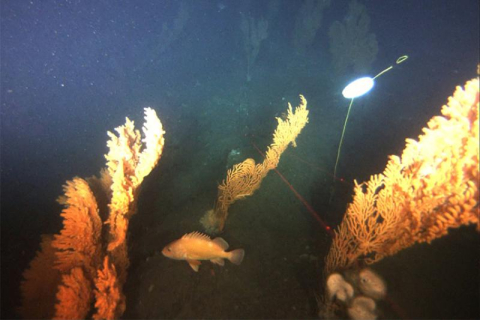
An Annotated and Illustrated Identification Guide to Common Mesophotic Reef Sponges (Porifera, Demospongiae, Hexactinellida, and Homoscleromorpha) Inhabiting Flower Garden Banks National Marine Sanctuary and Vicinities

In Flower Garden Banks National Marine Sanctuary region within the northwestern Gulf of Mexico, sponges thrive among diverse biological and geological habitats between 16–200+ m deep (i.e., coral reefs and communities, algal nodules, and coralline algae reefs, mesophotic reefs, patch reefs, scarps, ridges, soft substrate, and rocky outcrops).
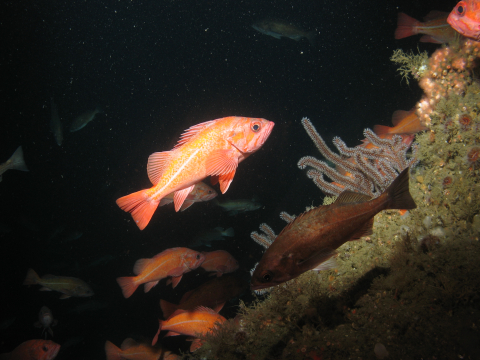
First In Situ Observation of an Aphyonid Fish (Teleostei, Ophidiiformes, Bythitidae)

Aphyonids are poorly-known, live-bearing brotulas (Ophidiiformes, Bythitidae) that until recently were considered to be in a distinct family, Aphyonidae. A single, ca. 9.3 cm total length aphyonid observed during a remotely-operated vehicle survey in the Mariana Archipelago at 2504.2 m on Explorer Ridge (20.68152°N, 145.08750°E) is the first seen alive in its natural habitat.

The Unknown and the Unexplored: Insights Into the Pacific Deep-Sea Following NOAA CAPSTONE Expeditions

Over a 3-year period, the National Oceanic and Atmospheric Administration (NOAA) organized and implemented a Pacific-wide field campaign entitled CAPSTONE: Campaign to Address Pacific monument Science, Technology, and Ocean NEeds. Under the auspices of CAPSTONE, NOAA mapped 597,230 km2 of the Pacific seafloor (with ∼61% of mapped area located within US waters), including 323 seamounts, conducted 187 ROV dives totaling 891.5 h of ROV benthic imaging time, and documented >347,000 individual organisms.

Mariana Serpentinite Mud Volcanism Exhumes Subducted Seamount Materials: Implications for the Origin of Life

Here, we present (1) the first observation of an extensive exposure of an undeformed Cretaceous seamount currently being subducted at the Mariana Trench inner slope;(2) vertical deformation of the forearc region related to subduction of Pacific Plate seamounts and thickened crust; (3) recovered Ocean Drilling Program and International Ocean Discovery Program cores of serpentinite mudflows that confirm exhumation of various Pacific Plate lithologies, including subducted reef limestone; (4) petrologic, geochemical and paleontological data from the cores that show that Pacific Plate seamount e

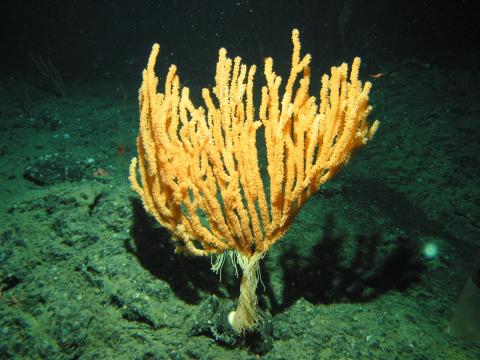
Primnoidae (Cnidaria: Octocorallia: Calcaxonia) of the Okeanos Explorer Expeditions (CAPSTONE) to the Central Pacific

*Journal subscription required to access

This paper discusses and illustrates the 23 primnoid species collected by the R/V Okeanos Explorer in the US marine protected areas in the central and western Pacific, ranging from the Musician Seamounts in the north to American Samoa to the south, and the northern Mariana Islands to the west (CAPSTONE expeditions, 2015-2017). In situ photographs are provided for most species.

New Species of Stylasterid (Cnidaria: Hydrozoa: Anthoathecata: Stylasteridae) from the Northwestern Hawaiian Islands

A new species of Crypthelia, C. kelleyi, is described from a seamount in the Northwestern Hawaiian Islands, making it the fifth species of stylasterid known from the Hawaiian Islands. Collected at 2,116 m, it is the fourth-deepest stylasterid species known.

The Fina Nagu Volcanic Complex: Unusual Submarine Arc Volcanism in the Rapidly Deforming Southern Mariana Margin

In the Mariana convergent margin, large arc volcanoes disappear south of Guam even though the Pacific plate continues to subduct and instead, small cones scatter on the seafloor. These small cones could form either due to decompression melting accompanying back-arc extension or flux melting, as expected for arc volcanoes, or as a result of both processes.

Subscribe to Journal article